Arne Bang
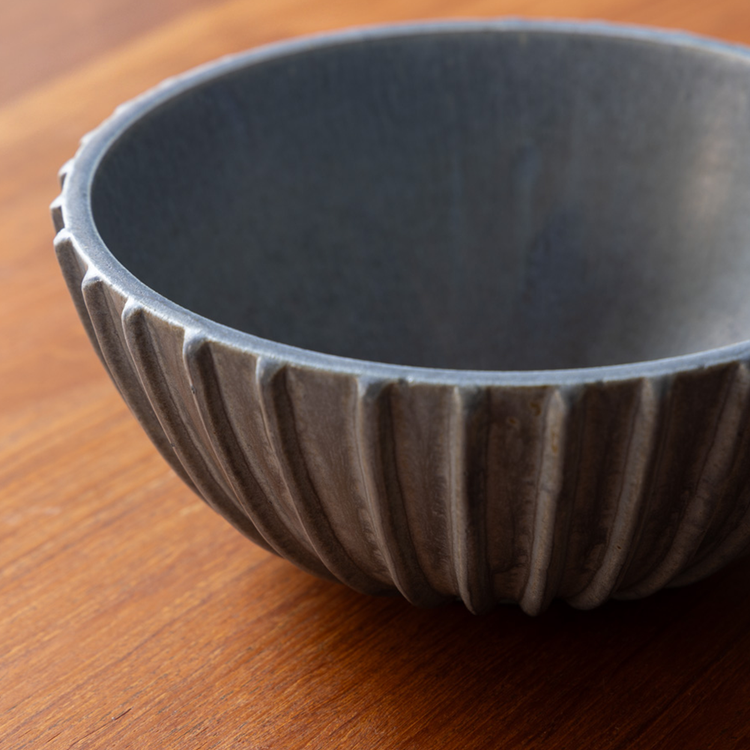
Arne Bang (1901–1983) was a sculptor and ceramist, known for his stoneware from Holmegaard Glasværk. His iconic ribbed vases, bowls and sculptures combine classical sculptural art with functional applied art – works that are today among the most sought-after collectibles in Danish design.
Arne Bang (1901–1983)
Danish sculptor and ceramist – Holmegaard's stoneware master
"I don't go to museums - anything more, but of course there's Rodin. Besides, the world is full of wonderful things, and apart from a statue by Sophus Claussen, which meant a lot to me, I have absolutely no ideas for the future." - Arne Bang
Arne Bang was one of the most significant Danish artisans of the 20th century. Trained as a sculptor, but internationally known as a ceramist, he combined sculptural heft with functional applied art. His stoneware from Holmegaard Glasværk is today among the most sought-after Danish design classics, characterised by a mix of classicist form, art deco details and inspiration from Japanese art.
Background and education
Arne Bang was born in 1901 in Frederiksberg, the son of the artist Hans Peter Carl Christian Bang and brother of the glass designer Jacob E. Bang. It was decided early on that he would attend the Royal Danish Academy of Fine Arts' School of Sculpture. He apprenticed with sculptor Niels Hansen (1917–19), where he participated in the restoration of the Marble Bridge at Christiansborg Palace, and was then admitted to the academy under Professor Einar Utzon-Frank (1920–25, 1928–29). His graduation work was the sculpture A Fallen Warrior , which today stands at Vestre Kirkegård as a memorial to those who fell in 1940.
A decisive turning point came in 1925, when he accompanied his brother Jacob to Paris. Here they participated in the construction of Kay Fisker's Danish pavilion for the World Exhibition, and Bang was strongly inspired by Japanese art and crafts, whose sense of simplicity and understanding of materials later influenced his ceramics.
Career and work
Arne Bang's early breakthrough came in collaboration with the ceramist Carl Halier at the Copenhagen Stoneware Kiln (1926–27). Halier turned and Bang modeled – a partnership that resulted in works that immediately attracted attention in the press. The collaboration gave him important experience with glazes and the possibilities of stoneware. He also provided designs for silver and pewter for Henning Wolfhagen in the late 1920s.
In 1929 Bang joined Holmegaard Glasværk, where he established and managed the stoneware production. Here he created works that were popularly called “The Gift” – functional and artistic everyday objects of high quality, but at a price that many could afford. From 1948 he ran Holmegaard Stentøj as an independent company, and in 1953 he established his own workshop in Fensmark, where he continued production for the rest of his life.
At the same time, he worked as a sculptor and created monumental decorations for schools, churches and public squares. His work therefore ranged widely – from small decorative dishes to large sculptures such as the Fladså troll in Næstved (1944). He also taught at Holmegaard Technical School and influenced the understanding of craftsmanship and design for generations.
Design features
Arne Bang's ceramics are characterized by sculptural, often monumental forms with decorative ribs, grooves or geometric patterns. He experimented with glazes in deep shades and was inspired by both art deco and the simple idiom of functionalism. His works move between sculpture and applied art: dishes, vases, bowls, lamp bases and figures with a heaviness and radiance that still make them unmistakable. This mix of art and functionality meant that his works found their way into both ordinary homes and royal collections.
Famous works
- The Tycho Brahe vase (1927, with Carl Halier) – made for the Copenhagen Observatory.
- The Elephant (1930) – ceramic figure with humor and gravity.
- The Kuglevasen (1937) – created for King Christian X, today a masterpiece in Danish stoneware.
- The Fallen Warrior (1929–42) – memorial at Vestre Cemetery, Copenhagen.
-
The Fladså Troll (1944) – monumental sculpture, Næstved's landmark.
Producers and collaboration
- Holmegaard Glassworks – established stoneware production (1929–48).
- Holmegaard Stoneware – Bang's own company from 1948.
-
Own workshop - From 1953, close to Fensmark.
- Carl Halier / KSB – early ceramic collaborations.
- A. Michelsen – silver and enamel works, including Christmas spoons and centerpieces.
- Henning Wolfhagen – silver and tin production.
- Schous Factories – ceramic works.
- etc.
Legacy and legacy
Arne Bang died in 1983 in Fensmark, where he is also buried. He left behind a unique legacy as a sculptor and ceramist, and his works can be found today at Designmuseum Danmark, Næstved Museum and Vejen Kunstmuseum. His stoneware is traded at international auctions and is highly sought after by collectors in Europe, the USA and Japan. With his special eye for materials, his sculptural starting point and a rare ability to combine artistic depth with functionality, Arne Bang stands as one of the great figures in Danish handicraft.
Experience Arne Bang's works at KLASSIK
At KLASSIK you will find original works by Arne Bang – from the characteristic ribbed vases to sculptural dishes and rare stoneware figurines. All works are carefully selected for authenticity and quality.
If you can't find the exact work you are looking for, we are happy to help you. Contact us at support@klassik.dk or call 33 33 90 60 – or visit us at Bredgade 3, Copenhagen.