Ole Wanscher
Ole Wanscher (1903–1985) was a Danish furniture designer who combined functionalism and classical elegance. He created iconic furniture such as the Colonial Chair, the Egypt Chair and the Senator series in collaboration with master cabinetmakers such as AJ Iversen and manufacturers such as P. Jeppesen and France & Daverkosen.
Ole Wanscher (1903–1985)
Danish furniture architect – classic functionalism with historical roots
Ole Wanscher was one of the most prominent representatives of Danish furniture design. He combined the ideals of functionalism with inspiration from historical furniture traditions – especially English 18th century furniture design. The result was elegant, well-proportioned and durable furniture that today stands as a masterpiece of Danish Modern.
Background and education
Ole Wanscher was born on 16 September 1903 in Frederiksberg, the son of art historian Vilhelm Wanscher and painter Laura Zeuthen. He attended technical school, participated in archaeological surveys for the National Museum in 1924, and was admitted to the Royal Danish Academy of Fine Arts' School of Architecture the same year, where he studied under Kaare Klint. From 1925 to 1927 he worked as an employee for Klint, and here he found the principles of function, materials, and proportion that would become the basis for his entire work.
Career and work
After establishing his own design studio in 1929, Ole Wanscher specialized in furniture and developed a close collaboration with cabinetmaker AJ Iversen. This collaboration resulted in some of the most exclusive and refined works in Danish furniture design. Wanscher's furniture was often a further development of classic furniture types, but refined with slender dimensions, precise lines and supple shapes.
From 1931 to 1936 he taught furniture design at the School of Arts and Crafts, and from 1955 to 1973 he was a professor at the Danish Academy of Fine Arts' Furniture School, where he took over the chair from Kaare Klint. He became one of the school's most central figures and shaped an entire generation of Danish architects and furniture designers. In addition to teaching, he participated in numerous exhibitions both in Denmark and internationally and was honored with, among other things, the gold medal at the Triennale in Milan in 1960 and the Cabinetmakers' Guild's Annual Prize in the same year.
Wanscher was also an important writer and researcher. He wrote a large number of articles and works, including Møbelkunstens Historie i Oversigt (1941), Møbelkunsten (1946–55, new ed. 1966), Engelske Møbler (1944) and Møblets Æstetik (1985). His research into furniture typology – especially the folding chair – cemented his reputation as both a theorist and practitioner who understood how to connect the furniture art of the past with contemporary functionalism.
Iconic furniture by Ole Wanscher
Most Ole Wanscher furniture combines classical form with modern simplicity. With a sense of proportion and construction, Wanscher created furniture that balances the functional and the refined – furniture that is still considered among the most harmonious works of Danish design.
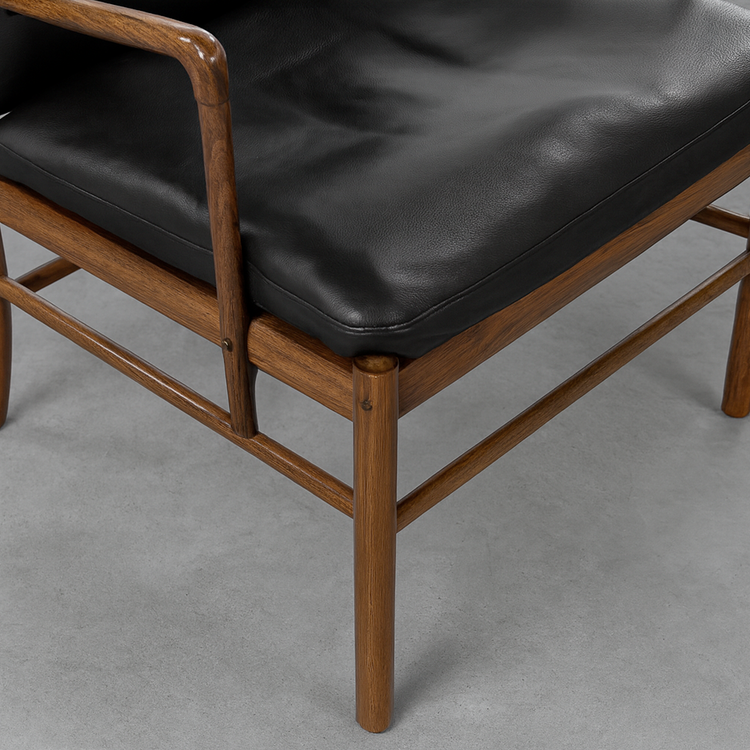
- Colonial Chair (PJ 149) – Wanscher's best-known work from 1949, a light and refined armchair often in rosewood/mahogany with a wicker seat and loose cushions. A masterpiece of Danish furniture design.
- The Egyptian Chair – Inspired by ancient folding chairs. Foldable, but with a classic elegance that combines historical inspiration and modern functionalism.
- Senator series – Sofa sets and armchairs with clean lines and great comfort, designed in the 1950s and produced by France & Daverkosen (later France & Søn).
- Rungstedlund series – Elegant furniture series named after Karen Blixen's home, developed with P. Jeppesen, characterized by a refined and classic design language.
- The Windsor Chair – A modernized interpretation of the classic English type, crafted in slender proportions with Wanscher's signature lightness.
- The PJ 112 chair – A comfortable lounge chair with wide armrests that demonstrates Wanscher's ability to create both robustness and elegance.
- OW Daybed – Strictly designed daybed with wooden frame and upholstered mattress, an example of Wanscher's sense of proportion and simplicity.
- The Princess Desk – Designed for Princess Margrethe in the 1950s, a mahogany desk with a light and functional appearance.
- The T-chair – Simple dining chairs with T-shaped backrests, elegant and functional in both homes and public spaces.
- FD 120 Rocking Chair – Comfortable rocking chair produced by France & Daverkosen, refined in both form and comfort.
-
The Armchair – Classic chair with armrests that combines Wanscher's study of historical furniture with a timeless modern expression.
Producers and collaboration
- AJ Iversen – Master cabinetmaker and one of Wanscher's most important partners. Together they created many of the finest pieces of Danish furniture, made from exclusive woods and with an unsurpassed quality of craftsmanship.
- P. Jeppesen – From the 1950s, P. Jeppesen produced several of Wanscher's well-known furniture, including the Colonial Chair and the Rungstedlund series.
- Fritz Hansen – Production of individual chairs and tables, where Wanscher explored industrial methods and materials.
- Rud. Rasmussen – Known for cabinetmaking quality, produced selected furniture in close collaboration with Wanscher.
- Thorald Madsen – Small production of chairs and tables with classic details and simple lines.
- France & Daverkosen – Produced the Senator series and several other upholstered furniture, which became popular export items in the 1950s.
- Jacob Kjær – Exclusive master cabinetmaker who made individual pieces of furniture in small series with a high level of craftsmanship.
-
Peder Pedersen – Production of more tables and chairs in a more accessible, functional style.
Legacy and legacy
Ole Wanscher died in 1985. His furniture is now considered a classic and is sought after at both Danish and international auctions. With his combination of functionalist rigor and classical inspiration, he stands as one of the most important representatives of Danish Modern. His Colonial chair and Egyptian stool are today among the most iconic Danish furniture from the 20th century.
Experience Ole Wanscher's original furniture at KLASSIK
At KLASSIK you will find original furniture by Ole Wanscher – including the Colonial Chair, Egyptian Chair and other iconic works – all carefully selected for their authenticity and quality.
If you can't find the exact piece of furniture you're looking for, we're happy to help. Contact us at support@klassik.dk or call 33 33 90 60 – or visit us at Bredgade 3, Copenhagen.